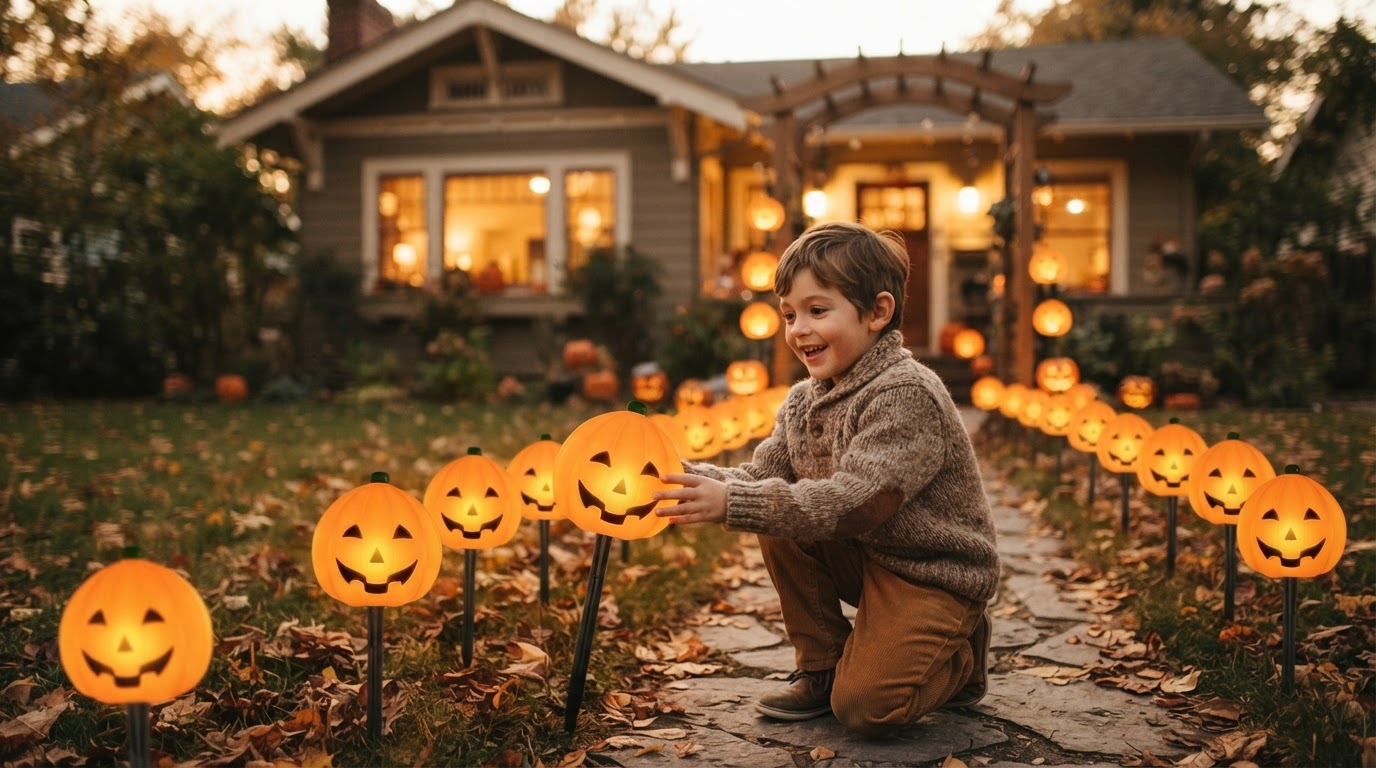
Optimizing Outdoor Lighting with the solar Pumpkin Stake
 Maya ChenContributing Editor
September 16, 2026. This analysis evaluates the technical deployment of the solar Pumpkin Stake in residential landscapes. It is intended for homeowners seeking to balance seasonal aesthetics with energy-efficient hardware.
The Efficiency Gap in Seasonal Lighting
The conventional wisdom says that seasonal garden displays require a trade-off between visual impact and electrical overhead. Most residential autumn setups rely on high-wattage incandescent strings or battery-operated plastic units that fail within a single season due to moisture ingress. In the context of the broader market for [solar fall lawn decorations](/blog/solar-fall-lawn-decorations), the industry often prioritizes short-term brightness over long-term battery cycle health. According to Reddit discussions regarding jack o lantern garden stakes, users frequently report frustration with the rapid dimming of low-capacity lithium-ion cells in cooler temperatures. Run the math: a standard 200mAh battery paired with a generic polycrystalline panel rarely sustains peak lumen output for more than three hours after sunset in northern latitudes. This failure is not a limitation of solar technology itself, but of poor component matching. When homeowners integrate [light up pumpkin garden decor](/blog/light-up-pumpkin-garden-decor), they often ignore the specific solar irradiance requirements needed to charge a Ni-MH or LiFePO4 battery during the shorter days of September and October. The result is a landscape that looks vibrant at 6:00 PM but goes dark before the peak of evening activity. This inconsistency undermines the utility of the lighting as a safety feature for walkways, leaving property owners with non-functional plastic shells that contribute to seasonal waste cycles rather than sustainable property management.
Technical Implementation of the solar Pumpkin Stake
Addressing the failure points of generic seasonal lighting requires a shift toward hardware like the solar Pumpkin Stake, which is engineered for the specific light-harvesting conditions of the fall equinox. Unlike the generic models cited in consumer forums, this unit utilizes a high-conversion monocrystalline panel designed to capture photons even under partial cloud cover—a common environmental factor in late autumn. Here's the part nobody talks about: the placement of fall pathway lights solar is often dictated by aesthetic symmetry rather than solar access. The solar Pumpkin Stake mitigates this by utilizing a stake-mounted design that allows for precise height adjustment, ensuring the photovoltaic cell remains above the shade line of low-lying shrubs or fallen leaves. This is critical because even 10% shading on a solar cell can lead to a 50% drop in power output. Furthermore, the integration of these units into a broader strategy involving [halloween garden stakes solar](/blog/halloween-garden-stakes-solar) allows for a decentralized power grid across the lawn. By distributing individual power collectors (the pumpkins themselves) rather than relying on a single central panel, the system avoids the single point of failure common in tethered lighting strings. The internal circuitry is optimized for a low-draw LED output, which maintains a steady Kelvin temperature without the rapid thermal degradation seen in cheaper, over-driven diodes. This ensures that the light remains consistent throughout the night, rather than starting bright and fading to a dull orange glow within hours.
Deployment Logic and Selection Criteria
Choosing a solar Pumpkin Stake should be a data-driven decision based on the specific microclimate of the garden. I’ll change my mind when a manufacturer proves that a single-panel tethered system can outperform the redundancy of individual stakes in a high-foliage environment, but until then, the independent stake remains the superior architecture. When planning a layout that incorporates halloween garden stakes solar, homeowners must evaluate the southern exposure of their property to ensure the internal capacitors reach full charge. The following framework should be used to determine the viability of a solar Pumpkin Stake installation:
- Calculate the average daily sun hours for your specific ZIP code during the months of September and October.
- Identify potential shading obstructions such as roof overhangs, deciduous trees, and neighboring structures.
- Verify the IP (Ingress Protection) rating to ensure the internal electronics are sealed against autumn frost and heavy rain.
- Assess the ground composition to ensure the stake can be driven deep enough to remain stable in high-wind conditions.
- Determine the required spacing to achieve a continuous light path without creating dark spots that present tripping hazards.