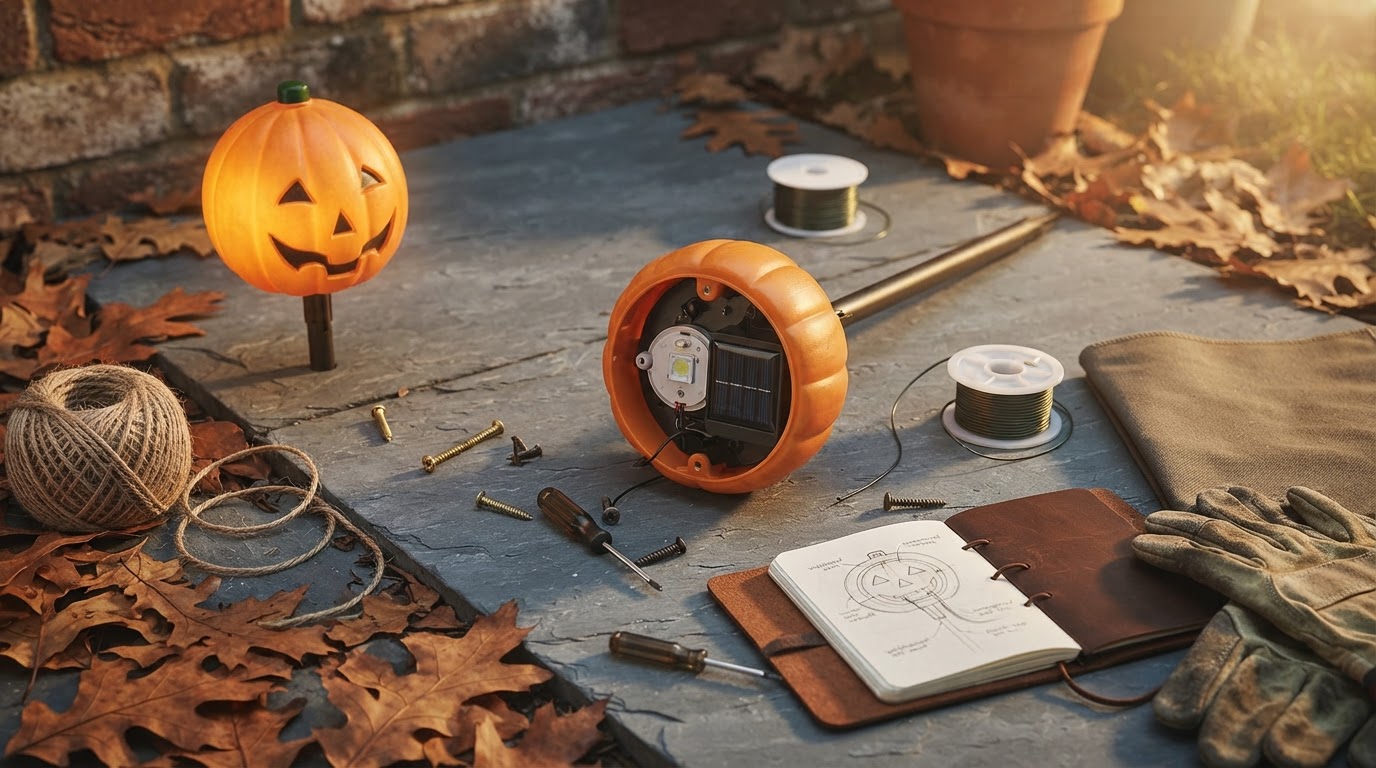
Optimizing Halloween Solar Garden Lights for Durability
 Maya ChenContributing Editor
September 6, 2026. This technical overview examines the functional limitations and performance benchmarks of Halloween solar garden lights. It is intended for homeowners seeking to move beyond disposable seasonal decorations toward reliable outdoor hardware.
The Failure Rate of Seasonal Decorative Lighting
The conventional wisdom says that outdoor holiday lighting is a temporary investment, expected to fail after a single season of rain or frost. Most consumers accept this planned obsolescence as a byproduct of low-cost manufacturing. However, the environmental and financial cost of replacing brittle plastic stakes annually is significant. According to the U.S. Department of Energy, LED lighting technology is inherently durable, yet the housing and solar integration in seasonal products often fail long before the diode reaches its end-of-life. Here's the part nobody talks about: the primary failure point in most decorative stakes isn't the light itself, but the moisture ingress at the seam of the solar panel and the degradation of the battery cell under fluctuating temperatures. When evaluating halloween garden stakes solar options, the market is saturated with units that lack basic IP65 waterproofing ratings, leading to internal corrosion within weeks of exposure. The assumption that seasonal items do not require industrial-grade sealing is a fallacy that leads to unnecessary waste. If a garden light cannot withstand a standard autumnal rain cycle, it serves no utility in a modern landscape design. We see this frequently in the proliferation of solar powered halloween yard art that prioritizes aesthetic complexity over mechanical integrity, resulting in products that look impressive in a showroom but fail in a damp garden bed.
Engineering Reliability with the solar Pumpkin Stake
Photo by Artūras Kokorevas on Pexels
Addressing these systemic failures requires a shift in how solar Pumpkin Stake components are sourced and assembled. Run the math: a standard nickel-metal hydride (NiMH) battery in a low-end stake may only survive 300 charge cycles, which is further reduced by the limited daylight hours available during the Halloween season. The solar Pumpkin Stake utilizes high-efficiency monocrystalline silicon panels that maximize energy conversion even in the indirect sunlight typical of late October. By integrating the solar cell directly into the top surface of the pumpkin housing, the design eliminates the vulnerable swivel joints found on generic jack o lantern garden stakes. This monolithic approach to the stake's structure ensures that wind and debris do not misalign the panel or snap the mounting point. Furthermore, the use of UV-stabilized resins in the pumpkin body prevents the chalking and fading common in orange pumpkin yard stakes that use cheaper, untreated plastics. The internal circuitry is coated in a moisture-resistant sealant, specifically targeting the corrosion points identified in standard consumer-grade electronics. While many products rely on a simple friction fit for the ground spike, the solar Pumpkin Stake employs a reinforced, tapered design to ensure vertical stability in varying soil densities, from packed clay to loose mulch. This focus on structural rigidity ensures that the illumination remains consistent regardless of weather shifts during the transition from early autumn to winter.
A Framework for Seasonal Outdoor Hardware Selection
Photo by Kim Lawrie on Pexels
When selecting hardware for an outdoor display, the focus must shift from initial cost to the total cost of ownership across multiple seasons. A higher upfront investment in a durable stake often pays for itself by the second year, once the replacement costs of inferior units are factored in. Buyers should scrutinize the connection points between the decorative head and the support pole, as these are the most common mechanical failure zones. I'll change my mind when manufacturers provide standardized wind-load ratings for garden stakes, but until then, physical weight and material density remain the best proxies for quality. Use the following criteria to evaluate your next seasonal lighting purchase:
- Verify the solar panel type; monocrystalline units outperform polycrystalline in the low-light conditions of the northern hemisphere's autumn.
- Inspect the battery compartment for a rubberized gasket seal rather than a simple plastic-on-plastic closure.
- Assess the stake material for flexibility; rigid, brittle plastics will snap in freezing temperatures, whereas high-density polyethylene or treated resins retain impact resistance.
- Check the light output consistency across the unit; high-quality LEDs should not flicker or dim significantly after three hours of operation.
- Look for integrated mounting systems that do not require external tools or adhesives, which tend to fail in high-humidity environments.